
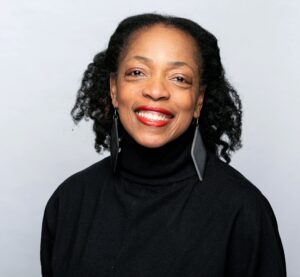
Faculty Mentor
About Olufemi
Olufemi’s Ph.D. research focuses on the intersection of theology, the arts, mental health, and public policy. Her goal is to promote mental health awareness and advocacy through the development of a mental health hermeneutic that utilizes fashion and art in the womanist framework as a liberative tool and model toward the eradication of stigma. A musician and writer by craft, she teaches creative writing, songwriting, commercial jingle writing, author study, poetry, and the philosophy of writing at California School of the Arts. As an adjunct professor, Olufemi teaches songwriting and contemporary vocal performance at Long Beach College and the Musicians Institute. Olufemi is a Madeleva Fellow at Saint Mary’s College, Notre Dame.
Education
Fuller Theological Seminary
2019, 2021
MAT Global Arts & World Religions and Master of Divinity
Berklee College of Music (Boston, MA)
1992
Contemporary Writing and Music Production
Dissertation
“Clothe Yourself in Christ: Womanist Fashion as a Liberative Model Toward a Mental Health Hermeneutics “
Research Interests
Womanism, hermeneutics, art, and bioethics/neuroethics
Publications
“Toward an Embodied and Transformative Theology” in Wisdom, Knowledge, and Faith: New Essays on the Future of Theology and the Episcopal Church
2026, Seabury Books
This essay offers a Womanist public theologian’s perspective on the future of theology in the Episcopal/Anglican tradition.
Damsels Versus Witches and the Battle for Women’s Identity in Narratives of Spiritism
2023, AAR-Western Regional Conference
Framed and influenced by folktales, fables, and screenplays, circles of exclusion are often perpetuated by labels and tropes projected onto the female gender. One would hope that once in a while there would be a story that expresses representations of the various types and shades of women. Much of what is represented frames women’s personalities, characters, and inner motivations within stereotypical binarism. Women are either perceived as helpless damsels or aggressive witches. They are interpreted as either submissive or venomously angry. These binaries, themes of bold contrast, are further complicated by race, ethnicity, class, and sexuality.
Why Women’s Theological Perspectives Matter for Teaching Psychology
2023, Journal for Psychology and Christianity, co-authored
Womanist theologies frequently speak of the “triple threat” of oppression which are the multiple discriminations of race, class, and gender that inform the Black female experience (Buchanan, 2008; Mitchem, 2008). In method, womanist theology provides a critique of racism in feminist theology and sexism in Black theology, and since many African American women have been negatively affected by the unequal distribution of wealth in the United States, it also addresses classism (Eugene, 1996).
Sexual Violence: Rape, Dismemberment, and the Determined Woman
2023, Don’t Look Away: The Horrors of Holy Scripture, Uncommon Voices Collective
In the aftermath, the woman lay at the threshold of the house like an old doormat. And a doormat she was. The man proclaims that he has witnessed the worst crime ever, but he is not upset about the woman’s abuse or rape. He is more concerned about the ill-treatment of his property. In Judges 19, an argument could be made that the dismembered body symbolizes the dissociated identity of the woman caused by betrayal and abuse.
Pauli Murray, Bell Hooks, and Love as a Tool for Reconciliation
2023, It’s All About Love: Jesus Movement Festival Conference
Bell Hooks and Pauli Murray were two Black women who most prevalently modeled the Black woman’s trinity of resistance, namely anger, joy, and love. Both women were Black female academics who entered studied literature as undergraduates. Also, both ended their journeys on earth as love warriors. Hooks authored books that integrated Black women’s perspectives on love as resistance in her pedagogy. Murray, who became the Episcopal Church’s first Black woman priest, insisted on drawing a larger circle to include the white males who excluded her throughout her journey as an academic, lawyer, and priest.
Fuller Seminary hosts these profiles as a courtesy to our doctoral students. Their views are their own and do not necessary reflect the views of the seminary.