

Doing Theology Through the Arts with W. David O. Taylor
W. David O. Taylor is associate professor of theology and culture. He is co-editor, with Daniel Train, of Naming the Spirit: Pneumatology Through the Arts (IVP 2025), which won IVP’s 2025 Readers’ Choice Award in Arts and Humanities. He is also the author of a number of other books, including the forthcoming To Set the World Aflame: How Artists Bear Witness to the Fullness of God’s Creation. He can be found on Substack and Instagram.
FULLER: In Naming the Spirit, you and co-editor Daniel Train write, “the arts are not simply decorative accessories to theological labors but can play a vital role in reinvigorating the discipline of theology [and] our study of Holy Scripture,” and further, “when we do theology through the arts, we discover things about theology that we could not have discovered through any other means.” In the book, contributors engage with the doctrine of the Spirit through various artistic pieces and lenses. Can you describe what it means to “do theology” through arts?
W. DAVID O. TAYLOR: In order to understand what it means to do theology through the arts, it may be helpful first to distinguish it from two related approaches: theological reflection on the arts and artistic representation of theological ideas. Historic examples of the former would be John of Damascus’ theological reflection on images and Hildegard of Bingen’s theological ruminations on music. Closer to home would be the work of Fuller Professor Kutter Callaway on television and theology. An example of the latter would be Henry Ossawa Tanner’s painting of the Annunciation or Dante’s poetic re-imagining of hell, purgatory, and paradise in his Divine Comedy.
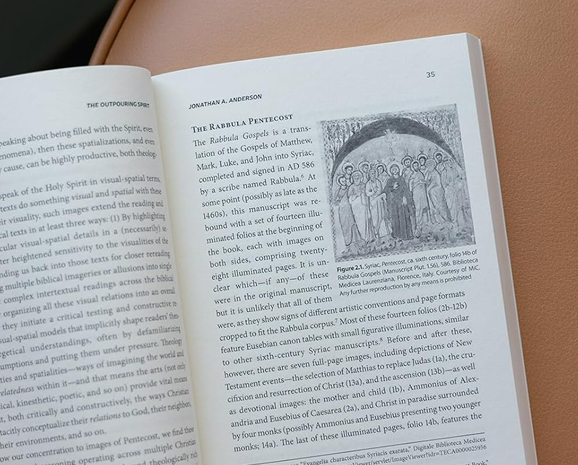
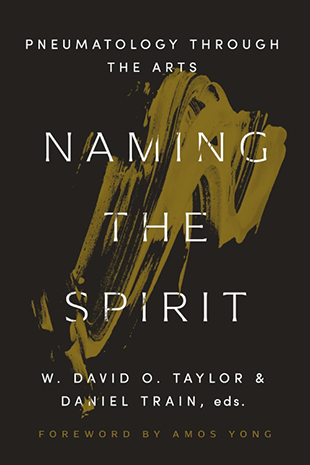 What we’re doing in Naming the Spirit is something different. We’re showing how theology can be done through the arts. For example, one of its contributors, Jonathan Anderson, shows how a sixth century Syriac painting of the events of Pentecost is not simply a visualization of the descent of the Holy Spirit upon the disciples but a theological commentary on the meaning of the church. Originally in Luke’s account, the Spirit is materially represented by a rushing wind and tongues of fire. But in the “Rabbula Pentecost” painting, the artist inserts a dove into the scene. His point being this: Just as the Spirit hovers over the chaotic waters of Genesis 1 and brings forth creation, so here at Pentecost, the Spirit hovers over the church to bring forth a new creation. And just as the Spirit hovers over the body of Christ at his baptism in order that Christ might be an agent of God’s peaceable kingdom, so here the Spirit hovers over the Body of Christ, symbolized in the twelve disciples and Mary, in order to make them agents of this peaceable kingdom.
The basic contention of our book, then, is that art can become a form of constructive engagement with doctrine, enriching and enlarging our confession in the Triune God. Art can do so because it functions as a distinctive mode of reasoning, which enables us to know the things of God’s world through imaginative, sensory, affective and metaphoric means.
FULLER: How does engaging with the arts in this way offer something theological which a sermon, or a book, or a lecture might not?
W. DAVID O. TAYLOR: Allow me to answer this question by sharing a story about the nineteenth-century poet and priest, Gerard Manley Hopkins. In the aftermath of the tragic death of five Franciscan nuns in 1975, Hopkins chose neither to preach a sermon nor to write an essay. Instead, he wrote a thirty-five-stanza epic poem that he titled “The Wreck of the Deutschland.” In it he told the story of a horrific shipwreck and of the nightmarish ordeal that its passengers had to endure. In the case of the nuns, this meant death.
 In reading it, we ourselves feel firsthand the terror of God’s sovereignty that “heeds but hides.” We sense the agony of the nuns, whom Hopkins makes active participants in the “passion-plungèd” Passion of the Christ. We imagine ourselves as fellow passengers, joined to the nuns in death, “sisterly sealed in wild waters.” And we witness one nun rearing herself to “divine Ears,” as we ourselves might under similar circumstances, trying desperately to make sense of the senseless, so that we might glimpse, even if only through a glass darkly, the goodness of God in the midst of “hurling and horrible” tragedies such as this.
The way to the heart of the tragedy, for Hopkins, was through poetry, not despite or beyond it. Art as such became the high road, not the wrong road, to the truth of the matter: to the feel of its horror, to the sense of its agony, to a picture of universal sorrow, and to a way of figuring out a harrowing reality through figurative means. This is what art can do that neither a sermon nor a lecture nor a book can do.
FULLER: Considering the current contexts of our present world, is there a specific way you imagine—or hope—the arts might uniquely help the church for faithful living today?
W. DAVID O. TAYLOR: One of the superpowers of the arts is to enable us to imagine that things need not and will not go on just as they are but as God will have them, as Stanley Hauerwas once said. In the face of relationally fracturing forces and distortions of justice and perversions of mercy, the Holy Spirit continues to inspire artists to create new songs and films and plays and novels, amongst other things, that enable us to imagine what often seems un-imaginable: the reconciliation of friends who had become enemies, hardened hearts that soften and repent, suspicion of neighbors that transforms into sacrificial love for them, and plenty more besides.
FULLER: What does Fuller Seminary have to offer to a Christian leader hoping to grow in their understanding of doing theology through the arts?
W. DAVID O. TAYLOR: Fuller has two faculty who are profoundly committed to the field of theology and the arts, myself and Kutter Callaway. It also has a good number of amazing affiliate faculty, like Shannon Sigler, our director of the Brehm Center for Worship, Theology, and the Arts. We’ve got a Concentration in Theology and the Arts that a person could do in the MA in Theological Studies program. And we have a Certificate in Theology and the Arts through Fuller Equip that anybody can get, outside of the degree program—at your own pace and to learn for the joy of it.
Interested in learning more about what it means to do theology through the arts and in studying with W. David O. Taylor? Learn more about the many programs, resources, and initiatives of Fuller’s Brehm Center, which equips artists and ministry leaders for service in any number of contexts to integrate worship, theology, and the arts for the renewal of church and culture.
Jun 3, 2026
Fuller’s Master of Arts in Theological Studies (MTS) provides a well-rounded, rigorous program that prepares students for further academic study and to be thought leaders in the contexts to which they are called.Master of Arts in Theological Studies